Blog: Electric Cars: Everything You Need To Know About Charging
If you're thinking of switching to an electric car, one of the biggest changes from petrol or diesel is understanding how to charge it. Here's everything you need to know.
How Do I Charge An Electric Car?
Electric cars are charged by connecting the car to a charging point via a cable provided with the car. This could be to a home charging port on your drive or garage, or via a public charging point.
The majority of electric cars have a Type 2 socket and therefore come with a Type 2 electric charging cable.
Charging cables and ports are relatively standardised (except some rapid and ultra-rapid charging ports), so you’ll be able to charge your car at most charging points.
What’s The Difference Between Slow, Fast, Rapid and Ultra-Rapid Charging?
There are four main types of charging currently available for electric vehicles in the UK.
Level 1: Slow Charging (AC)
This is the sort of charging that usually takes place at home, or at work. Generally, an electric vehicle will need to be tethered to a regular mains supply for around 6-12 hours to gain a full charge. Slow charging is usually rates at 3kW AC. Connectors used for this type of charging include Type 1 and Type 2. Generally, the charging cable provided with your electric vehicle will be used to tether to a slow charging point.
Level 2: Fast Charging (AC)
Fast charging points are most common in public parking areas, like supermarkets and shopping centres. A full charge can take between 1 and 5 hours, depending on the charging type. Level 2 fast charging is rated at either 7kW (single-phase AC) or 22kW (3-phase AC). Fast charging connector types vary and the same connectors are used as those for slow charging. Most vehicles can plug into any supply provided they have the correct cable.
Level 3: Rapid Charging (DC)
Rapid charging devices mostly deliver around 50kW and can charge a vehicle’s battery to 80% full in 20-40 minutes. An hour of rapid charging can give a vehicle more than 120 miles of range. Compare this to fast charging, which would provide just 20-25 miles per hour of charging.
Level 4: Ultra-Rapid Charging (DC)
This is the latest charging technology to become available in the UK. Delivering upwards of 100kW, ultra-rapid charging can fully replenish a vehicle’s battery within 20 minutes.
Do All Electric Cars Use The Same Charger?
Most electric cars can use any charging point (minus some rapid and ultra-rapid charging points), but the charging cable needed to charge the car may differ depending on the model of car.
The Types of Electric Car Charger Connector Types
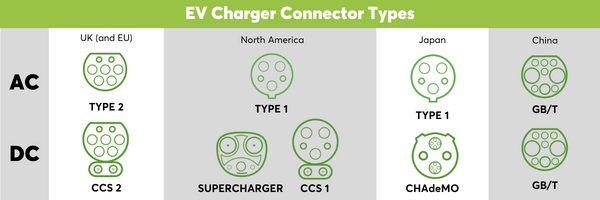
Type 2
Every new electric car comes with a Type 2 connector socket. Type 2 EV charging plugs deliver electricity via alternating current (AC), and generally don’t charge any faster than 22kW.
CCS
Almost every EV sold in the UK today also comes with a CCS socket. Short for Combined Charging System, a CCS plug utilises the same socket as the Type 2 plug, but features an additional two prongs that allow direct current (DC) to be delivered to the car. This allows for much faster charging than that provided by a Type 2 socket. Rapid and ultra-rapid charging are facilitated by CCS plugs.
CHAdeMO (Japan)
CHAdeMO is the charging standard favoured by Japanese car manufacturers including Nissan, Mitsubishi and Toyota. The name is a shortening of ‘CHArge de MOve’ or ‘move with charge’. The Nissan Leaf and Mitsubishi Outlander PHEV are effectively the only modern cars that use CHAdeMO in the UK. Nissan moved to CCS plugs when it launched the new Ariya EV.
Tesla Supercharger – North American Charging Standard (NACS)
Tesla developed and deployed their own proprietary charging solution. Tesla’s ‘supercharger’ system is more powerful than CCS or CHAdeMO and capable of charging at 120kW. This would provide a range of 300+ miles within an hour charge.
The Tesla supercharger network, in most cases, only works with Tesla cars. Tesla is now opening its charging design to other electric vehicle manufacturers in North America – hence North American Charging Standard.
Tesla connectors are based on Type 2 and CCS charging plugs, with older examples of the Model S and Model X using Type 2, while the Model 3, Model Y and newer versions of the Model S and Model X use the CCS socket.
GB/T (China)
China also has its own charging standard: GB/T. While it’s only used by Chinese manufacturers, there are still more GB/T charging stations globally than either CHAdeMO, CCS or Tesla.
What’s The Difference Between Tethered and Untethered EV Charging Cables?
Tethered
A tethered cable is one that is hardwired to an EV charging point. All public, rapid charging points are tethered. Public fast chargers, and home charging points, can be tethered or untethered.
Untethered
An untethered cable means a charger has a socket into which a charging cable can be plugged in.
You’ll often see public EV charging points described as ‘tethered’ or ‘untethered’. Essentially, if it’s ‘tethered’ it has its own cable attached. If it’s ‘untethered’ you’ll need to plug your own charging cable into the charging point.
Can I Charge My Electric Car Using A 3-Pin Plug?
You can charge an electric car using a 3-pin plug, however it’s not recommended as a long-term solution. The length of time it takes to charge from a domestic plug is considerably longer than a Type2 charging cable. The amount of electricity needed to charge your electric car is much higher than a normal domestic appliance, so it’s safer, quicker and easier to have a proper charging point installed at your address.
How Do I Get An Electric Car Charging Point Installed At Home?
If you have off-street parking and drive an electric car, it’s a good idea to get a dedicated charging point installed.
We’ve partnered with leading EV charging point suppliers, Egg, to offer a hassle-free solution for xlcr customers. Read more about charging with Egg.
Installation is very straightforward, taking around half a day, and can be scheduled to fit around you.

How Do I Use A Public Charging Point?
The UK government and private companies are investing heavily in public electric charging points across the country. New points are being added to the public charging network daily.
As of January 2023, there were 62,332 electric charging connectors at 22,355 locations across the UK.
If you think you aren’t close to a charging point, it’s worth checking as some charging points aren’t noticeable. It’s only once you have an electric car that you realise quite how many charging points are already out there.
We recommend using ZapMap to find your nearest electric charging points.
How long will it take me to charge at a public charging point?
Charging times vary depending on the type of charging point, and available power. Here are some estimated charging times as a rough guide:
Slow charger (3kW-6kW): Up to 15 miles in 1 hour
Fast charger (7kW): Up to 30 miles in 1 hour
Fast charger (22kW): Up to 90 miles in 1 hour
Rapid charger (43-50kW): Up to 90 miles in 30 minutes
Ultra-rapid charger (11-150kW): Up to 200 miles in 30 minutes
Do all public charging points cost the same to use?
No. Each charging point will source its electricity from different providers, or they may have been installed as a courtesy (i.e. some charges at supermarkets are free to use). Something to bear in mind if the cost per kW hour when using a public charging point.
If you're planning to regularly use a particular charging location, or you only tend to charge in a particular area of the country, subscribing to a particular network may save you money in the long run.